
Specialty Contact Lenses in Mansfield, Texas
At Texas State Optical Mansfield, we provide specialty contact lens fittings for patients with complex vision needs, keratoconus, irregular corneas, dry eye disease, and other conditions that require a more customized approach to vision correction.
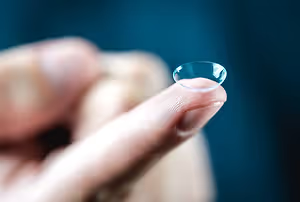
Contact Lens Options for Eyes That Need a Little More Support
Traditional contact lenses work well for many people, but they are not the best solution for every eye.
Patients who experience blurry vision, discomfort, dryness, unstable lenses, or difficulty achieving a successful fit may benefit from specialty contact lenses tailored to their unique needs.
Specialty contact lenses are often recommended when conventional lenses cannot provide the visual clarity, comfort, or stability needed for long-term success.
Why Specialty Contact Lenses May Be Medically Necessary
Many patients assume specialty contact lenses are simply an upgraded version of traditional contacts.
In reality, they are often medically necessary.
Certain eye conditions alter the eye's shape or function in ways that cannot be fully corrected with standard glasses or soft contact lenses. Specialty lenses are designed to address those challenges while helping patients achieve better vision and improved comfort.
Specialty contact lenses may be recommended for patients with:
- Keratoconus
- Corneal irregularities
- Severe dry eye
- Post-surgical corneal changes
- Complex prescriptions
- Contact lens intolerance
- Other hard-to-fit eye conditions
For many patients, specialty lenses provide the best opportunity for clear, functional vision.
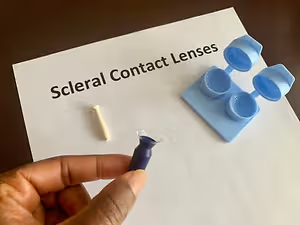
Scleral Lenses
Scleral lenses are large-diameter lenses that rest on the sclera, or white part of the eye, rather than directly on the cornea.
Because they vault over the cornea, scleral lenses create a smooth optical surface while maintaining a fluid reservoir between the lens and the eye. This design often provides exceptional visual clarity and comfort for patients with complex eye conditions.
Scleral lenses can:
- Provide exceptional clarity for irregular corneas
- Create a fluid reservoir that helps keep the eye hydrated
- Improve comfort for patients who struggle with traditional lenses
- Support visual rehabilitation for compromised corneas
Scleral lenses are often described as "vision restoration for the compromised cornea" because of the dramatic improvements many patients experience.

Rigid Gas-Permeable (RGP) Lenses
Rigid gas-permeable lenses are smaller, breathable lenses that maintain a stable shape on the eye.
Unlike soft contact lenses, RGP lenses create a consistent optical surface that can provide sharper vision for certain prescriptions and corneal conditions.
RGP lenses may be recommended for:
- Mild to moderate corneal irregularities
- Keratoconus
- High astigmatism
- Complex prescriptions
Because they can be customized to the individual eye, RGP lenses often provide clearer vision than traditional soft contact lenses.
Hybrid Lenses
Hybrid lenses combine two technologies into a single lens. They feature a rigid gas-permeable center surrounded by a soft outer skirt, allowing patients to benefit from the visual clarity of an RGP lens while enjoying the comfort of a soft lens.
Hybrid lenses are often recommended for:
- Astigmatism
- Keratoconus
- Patients sensitive to traditional RGP lenses
- Patients seeking improved comfort without sacrificing vision quality
We proudly fit SynergEyes® Hybrid Lenses as part of our specialty contact lens offerings.


Custom Soft Lenses
Some patients require soft contact lenses that go beyond standard designs.
Custom soft lenses are specially manufactured to accommodate unique prescriptions, eye shapes, and certain corneal conditions.
These lenses may be recommended for:
- Early keratoconus
- Mild corneal distortions
- High prescriptions
- Patients who prefer the comfort of soft lenses
For many patients, custom soft lenses provide an excellent balance between comfort and visual performance.
Orthokeratology (Ortho-K)
Orthokeratology, often called ortho-k, uses specially designed contact lenses worn overnight to gently reshape the cornea while you sleep.
The result is clear daytime vision without the need for glasses or contact lenses during waking hours.
Ortho-k is commonly used for:
- Vision correction
- Active lifestyles
- Myopia management in children
For children with progressive myopia, ortho-k can be an effective tool to slow prescription changes and support long-term eye health.


Prosthetic & Therapeutic Soft Lenses
Some specialty lenses are designed to do more than correct vision.
Prosthetic and therapeutic soft lenses may be used to protect damaged eye tissue, improve appearance, reduce glare, or improve comfort for patients with certain medical conditions.
These lenses may benefit patients experiencing:
- Eye trauma
- Light sensitivity
- Iris abnormalities
- Chronic eye discomfort
- Photophobia
Because these lenses are highly individualized, they are carefully selected and fitted based on each patient's specific needs.
Keratoconus Management
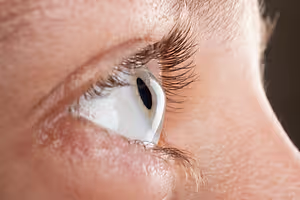
Keratoconus is a progressive eye condition that causes the cornea to thin and gradually change shape.
As the cornea becomes more irregular, vision often becomes distorted and difficult to correct with traditional glasses or contact lenses. Specialty contact lenses, particularly scleral lenses, are often used to create a more regular optical surface and improve visual clarity.
Our eye doctors work closely with patients to monitor their condition and recommend contact lens solutions that support long-term vision and comfort.
While specialty lenses do not stop keratoconus from progressing, they can play an important role in helping patients achieve better functional vision and maintain their quality of life.

Advanced Contact Lens Troubleshooting
Not every contact lens problem requires giving up contact lenses.
Patients frequently visit our eye clinic because they are experiencing discomfort, blurry vision, dryness, unstable lenses, or difficulty wearing contacts throughout the day. In many cases, the issue is not contact lenses themselves but rather the lens design, fit, material, or overall eye health.
Our eye doctors take a detailed approach to identifying the source of contact lens challenges and exploring solutions that may improve comfort and performance.
Sometimes, a different lens design is all that is needed. In other cases, specialty contact lenses may provide a better long-term solution.
Specialty Contact Lens Evaluation in Mansfield, Texas
A specialty contact lens evaluation allows our eye doctors to assess your eyes, discuss your previous contact lens experiences, and determine whether scleral lenses, hybrid lenses, custom soft lenses, or another specialty option may provide a better solution.